Orbea rethinks aerodynamics with the new Orca Aero
Estimated reading time: 3 minutes
In a professional peloton that breaks speed records every season, aerodynamics is no longer a matter exclusive to the frame, but a collective effort. That is precisely the philosophy behind the new Orca Aero, with which the Basque brand claims to have developed a bike-rider system capable of saving up to 21 watts compared to the previous generation.
Orbeadefines this concept as a Total System Approach, a vision that considers the bicycle and rider as a single aerodynamic configuration. The goal is no longer solely to reduce the drag of the frame, but also to optimize the rider’s position, the integration of components, and the behaviour of the system under real-world conditions.
To achieve this, Orbea has followed a development process combining computational fluid dynamics simulations, wind tunnel assessment, velodrome testing, and real-road trials. The result is an evolution of the Orca Aero introduced in 2022, a bike that already accumulated WorldTour victories, but whose new version revisits virtually every element with a single purpose: to move forward with the lowest possible resistance.
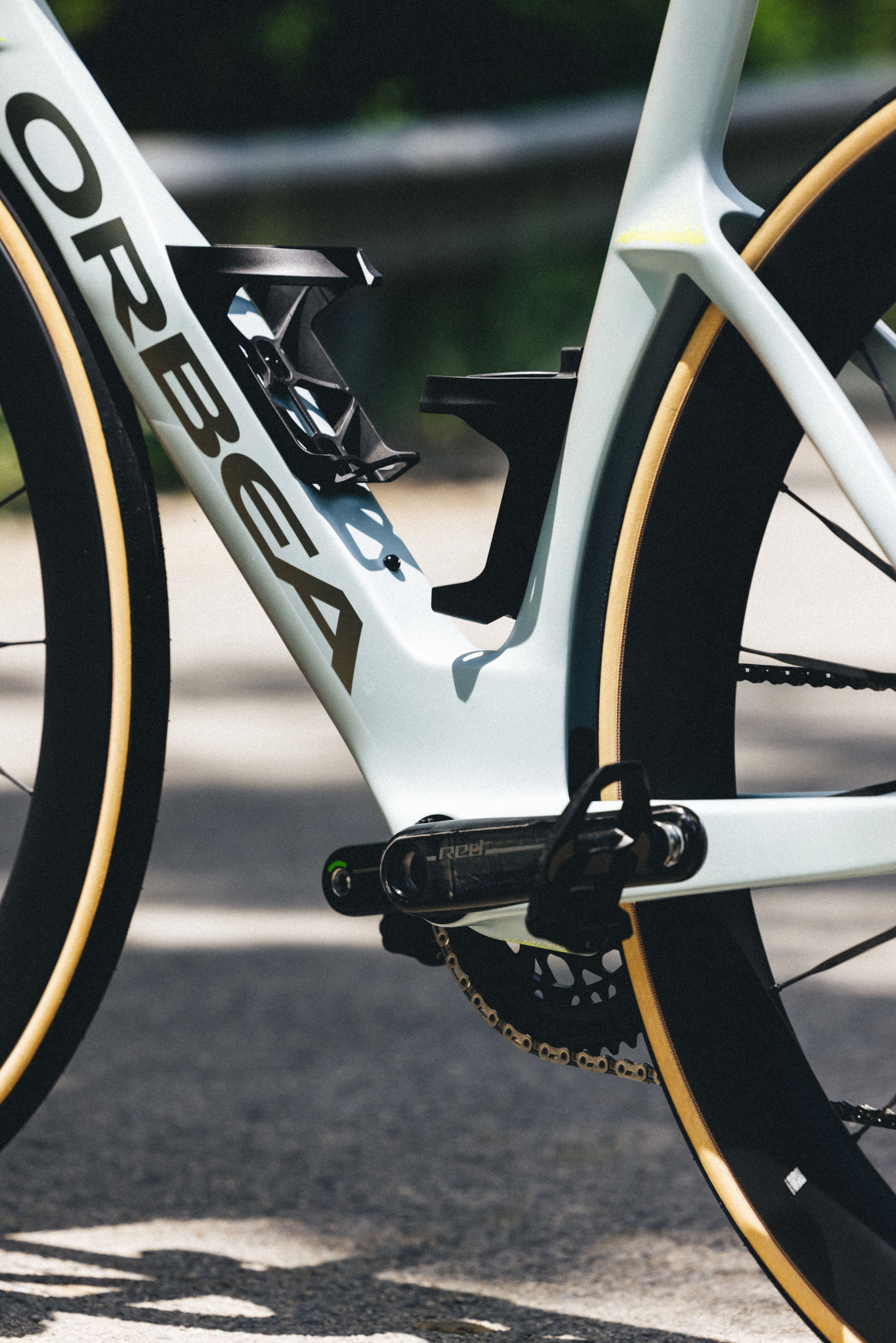
The changes affect the entire frame, as the head tube reduces its frontal area and the fork integrates more smoothly with the down tube. This tube adopts a wider profile to manage airflow more efficiently, and the seat tube is narrowed to reduce drag. The seatstays have also been redesigned —thinner and with a lower junction point— along with the bottom bracket area, reducing resistance at a critical transition point. Peripheral elements such as the new bottle cages, the Service Box, the OC RA10 integrated handlebar, and the OC RA11 aerodynamic seatpost have also been considered to ensure the systemic approach. According to Orbea, all these improvements reduce drag equivalent to 5.1 watts at 50 km/h.
However, most of the gain comes from incorporating the rider into the equation. The new Orca Aero adopts a 78 mm bottom bracket drop, the lowest on the market, to place the rider in a more stable and compact position, reducing both sway and the surface exposed to the wind. This is complemented by a wide range of cockpit and fit adjustments, with 13 handlebar options, different seatpost configurations, and spacers that allow precise optimisation of each rider’s position. The savings derived from this optimization of the system amount to approximately 14 watts at 50 km/h, according to Orbea’s calculations.
The new Orca Aero also adapts to current trends in competitive cycling. It accommodates tyre clearance of up to 37 mm, a feature that improves efficiency on cobbles and rough asphalt without compromising aerodynamics. At the same time, it maintains high stiffness, 93 Nm/°, with a frame weight of approximately 900 grams, a combination that also brings advantages when climbing.
In short, with this new generation Orbea does not aim to reinvent the aero bike, but rather presents a proposal focused on optimising the performance of all the elements involved, where every watt counts.